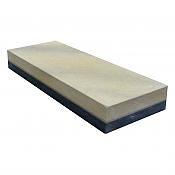





Combination Stone - Coticule and Belgian Blue Whetstone (200mm x 60mm)
Move your mouse over image or click to enlarge







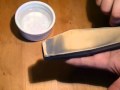
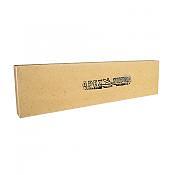
This combination stone has the famous yellow Coticule (8000 grit equivalent) on one side and the Belgian Blue Whetstone (4000 grit equivalent) on the other. Combine this with a slurry stone and you have many choices open to you on how you hone your razor.
The Coticule stone is a natural whetstone from the Belgian Ardennes region with a rich past dating back to the 17th century. It is a sedimentary rock formed over 480 million years, consisting of grey-yellowish volcanic ash and clay containing hard garnet crystals. Because of the way it is formed, the stone needs to be extracted meticulously and mostly without using machinery. This extraction is very time-consuming, labour-intensive and expensive work that can only occur a few months per year, due to the influence of all kinds of weather conditions. The production is 100% traditional and makes every stone a unique item.
Exceptional Sharpening Characteristics
Each Coticule consists of 30 to 42% garnet crystals bonded together with mica. These garnets are what give the Coticule its exceptional sharpening characteristics. The geometrical shape of these garnets is a dodecahedron. There are twelve surfaces with obtuse angles. The garnets have a diameter of 5 to 15 microns and penetrate 1 to 3 microns into the metal to be sharpened. This ideal geometric shape (obtuse angles polish the metal) and the large numbers of these garnets ensure that the blade is sharpened both very quickly and extremely finely. In just a few minutes, this results in a razor-sharp cut, for any object that is to be sharpened.
The Coticule is often compared to a 8000 grit whetstone, using the Japanese grit system, but it must be borne in mind that it is a natural product, and therefore no one stone is 100% identical to another. The grit rating is given purely for information, and tells you little about the specific characteristics of the stone. The advantage compared to other whetstones is that the Coticule sharpens very finely and very quickly, no other whetstone possesses this combination.
The hardness of the garnets ensures that they are able to hone any kind of steel, including stainless steel , Damascus Steel and HSS High Speed Steel.
The geometric shape of the garnets gives the whetstone another unique characteristic. The smooth shape of the garnets means that they sharpen the metal without leaving behind tiny burrs. Because of this, a razor sharpened with a Coticule does not damage the skin during shaving.
Selected Grade
Selected Grade means that the surface of the Coticule contains, apart from possible colour variations, no blemishes at all or only a tiny number, such as black lines or specks. Once again, this has no influence on the sharpening properties.
Sharpening with a Coticule
All that is required is to wet the Coticule surface; there is no need to immerse the stone. During sharpening, garnets are released from the Coticule surface. The more garnets are released, the more abrasive the grinding compound becomes.
A frequently-used method for increasing abrasiveness is to use a rubbing stone to produce a grinding compound with a high garnet content on the Coticule surface. This is done by rubbing the surface of the rubbing stone over the surface of the whetstone. The milky white grinding compound does not take long to appear.
For the fine honing, the grinding compound is diluted in a number of stages with a small amount of water until finally there is only water on the surface. This method, combined with the versatility of the Coticule, means that only one whetstone is needed for the entire sharpening process. Please see http://www.coticule.be/straight-razor-honing.html for more information on honing with a Coticule/Belgian Blue and in particular the sections on the Unicot (using only one honing stone) and Dilucot (using progressivley diluted slurry on the one stone) methods.
The Belgian Blue Whetstone, or BBW for short, is extracted together with and at the same location as the Coticule. The BBW was formed in the same way and at the same time as the Coticule. The presence of iron oxide in the stone explains the bluish purple colour. Just like the Coticule, the extraction of the BBW is a time-consuming task that must be carried out very meticulously, without the use of machinery. This extraction is very time-consuming, labour-intensive and expensive work that can only occur a few months per year, due to the influence of all kinds of weather conditions. The production is 100% traditional and makes every stone a unique item.
Exceptional Sharpening Characteristics
The Belgian Blue Whetstone is approximately identical to the Coticule and has almost identical sharpening characteristics. The BBW contains a maximum of 25% of garnets with a diameter of 10 to 20 microns. The geometrical shape of these garnets is a dodecahedron. There are twelve surfaces with obtuse angles. The BBW contains fewer garnets than the Coticule and those garnets are bigger. This means that the BBW sharpens slightly slower than the Coticule, but still very quick and extremely fine, resulting in a razor with a sharp blade. The BBW has greater hardness than the Coticule.
The BBW is often compared to a 4000 grit whetstone, using the Japanese grit system, but it must be borne in mind that it is a natural product, and therefore no one stone is 100% identical to another. The grit rating is given purely for information, and tells you little about the specific characteristics of the stone. The advantage compared to other whetstones is that the Coticule sharpens very finely and very quickly, no other whetstone possesses this combination.
The hardness of the garnets ensures that they are able to hone any kind of steel, including stainless steel , Damascus Steel and HSS High Speed Steel.
The geometric shape of the garnets gives the whetstone another unique characteristic. The smooth shape of the garnets means that they sharpen the metal without leaving behind tiny burrs. Because of this, a razor sharpened with a Coticule does not damage the skin during shaving.
Sharpening with a BBW
All that is required is to wet the BBW surface; there is no need to immerse the stone. During sharpening, garnets are released from the BBW surface. The more garnets are released, the more abrasive the grinding compound becomes.
A frequently-used method for increasing abrasiveness is to use a rubbing stone to produce a grinding compound with a high garnet content on the BBW surface. This is done by rubbing the surface of the rubbing stone over the surface of the whetstone. The bluish purple grinding compound does not take long to appear.
For the fine honing, the grinding compound is diluted in a number of stages with a small amount of water until finally there is only water on the surface. This method, combined with the versatility of the BBW, means that only one whetstone is needed for the entire sharpening process. Please see http://www.coticule.be/straight-razor-honing.html for more information on honing with a Coticule/Belgian Blue and in particular the sections on the Unicot (using only one honing stone) and Dilucot (using progressivley diluted slurry on the one stone) methods.
Flattening the combination stone
Place a piece of +/- 80 to 100 micron sandpaper on a flat surface. Put some water on it and rub the stone flat.
Working life of stone
The working life depends on the use. The more intensive the use, the faster the stone will be worn away. Generally speaking, our whetstones last 20 years in normal use.
Please Note: Use only water when sharpening, not oil. Oil is only used with porous stones to prevent iron particles remaining stuck in the pores.
 | Age Restricted Products. It is illegal to purchase razor blades and razors in the UK when under the age of 18. By purchasing through our website you are confirming that you are over the age of 18 when purchasing these items. We use age verification services and reserve the right to cancel your order if you are under 18. |